


Locations in a digital image are specified by a row number and a column number (both of them integers). A particular digital image is 1024 rows by 1024 columns, and each location holds one byte. How many megabytes are in that image?
Answer:
1024 * 1024 = 210 * 210 = 2(10+10) = 220 = one megabyte
Picture of Main Memory
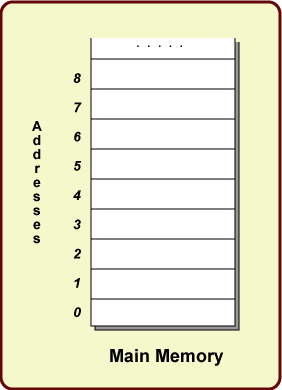
Main memory consists of a very long list of bytes. In most modern computers, each byte has an address that is used to locate it. The picture shows a small part of main memory:
Each box in this picture represents a single byte. Each byte has an address. In this picture the addresses are the integers to the left of the boxes: 0, 1, 2, 3, 4, ... and so on. The addresses for most computer memory start at 0 and go up in sequence until each byte has an address.
Each byte contains a pattern of eight bits. When the computer's power is on, every byte contains some pattern or other, even those bytes not being used for anything. (Remember the nature of binary: when a binary device is working it is either "on" or "off", never inbetween.)
The address of a byte is not explicitly contained in memory. When the processor needs to access the byte at a particular address, the electronics of the computer "knows how" to find that byte in memory.
QUESTION 7:
Decide which of the following are true:
- Each byte of main memory has a unique address.
- If main memory cotains 4 megabytes, there will be 4 * 220 addresses.