


Answer:
| type | description |
|---|---|
| counting loop | Uses a loop control variable to count upwards or downwards (usually by an integer increment.) |
| sentinel-controlled loop | Loop keeps going until a special value is encountered in the data. |
| result-controlled loop | Loop keeps going until a test determines that the desired result has been achieved. |
Fundamental Loops
Each type of loop can be built using the
while
along with other statements.
There
are three things
(in each of the three types of loops)
that must be done correctly:
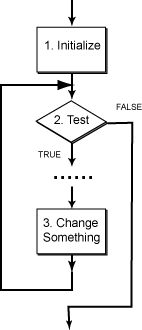
- The loop must be initialized.
- A condition must be tested.
- The loop body must change something that is tested.
Overlooking one of these aspects results in a defective loop. But usually each of these aspects is found in a different place in a program. No wonder that loops often go wrong!
The flow chart to the right shows what all loops must do.
It could be for any of the three types of loops.
The ellipses
QUESTION 2:
Would it be convenient to have all three aspects combined into one statement?