
The Stanford Space Weather Monitor Collaboration
Turning ionospheric research instrumentation into a student-accessible scientific experience required a two-way partnership between researchers and educators.
Authentic science without reducing it to a simulation
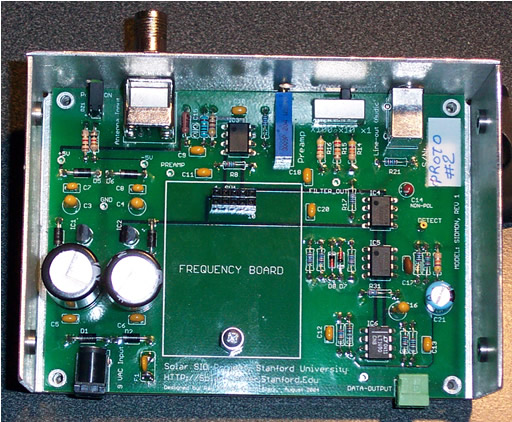
The SID system monitored Very Low Frequency radio signals whose propagation changes when solar activity disturbs the ionosphere. The educational challenge was to make that phenomenon measurable by students at a cost and complexity appropriate for schools.
Teachers and Stanford engineering/science participants redesigned the concept for education. Students could build antennas, collect data, investigate events, and contribute observations to a larger network.
Research Need
Observe changes in the lower ionosphere related to solar and atmospheric activity.
Educator Input
Translate technical research requirements into something workable in real classrooms.
Student System
Use affordable receiving hardware, student-built antennas, and computer-based data collection.
Inquiry
Connect local observations with solar data and broader scientific questions.
Why the collaboration matters
Co-design
Educators were not simply end users. Classroom expertise informed the design and implementation of the student monitor experience.
Mentorship
The project created relationships among teachers, students, scientists, and engineers rather than isolating school science from professional practice.
Global Reach
The program became part of the International Heliophysical Year effort and connected student observations to a much wider scientific community.